“Most Moral Army™ Deploys Chemical Weapons Against 5-Year-Olds”
Books Against Barbed Wire: The Children of Umm al-Khair Will Not Stop Learning
They came with drums, songs, and textbooks. Soldiers came with tear gas and wire.
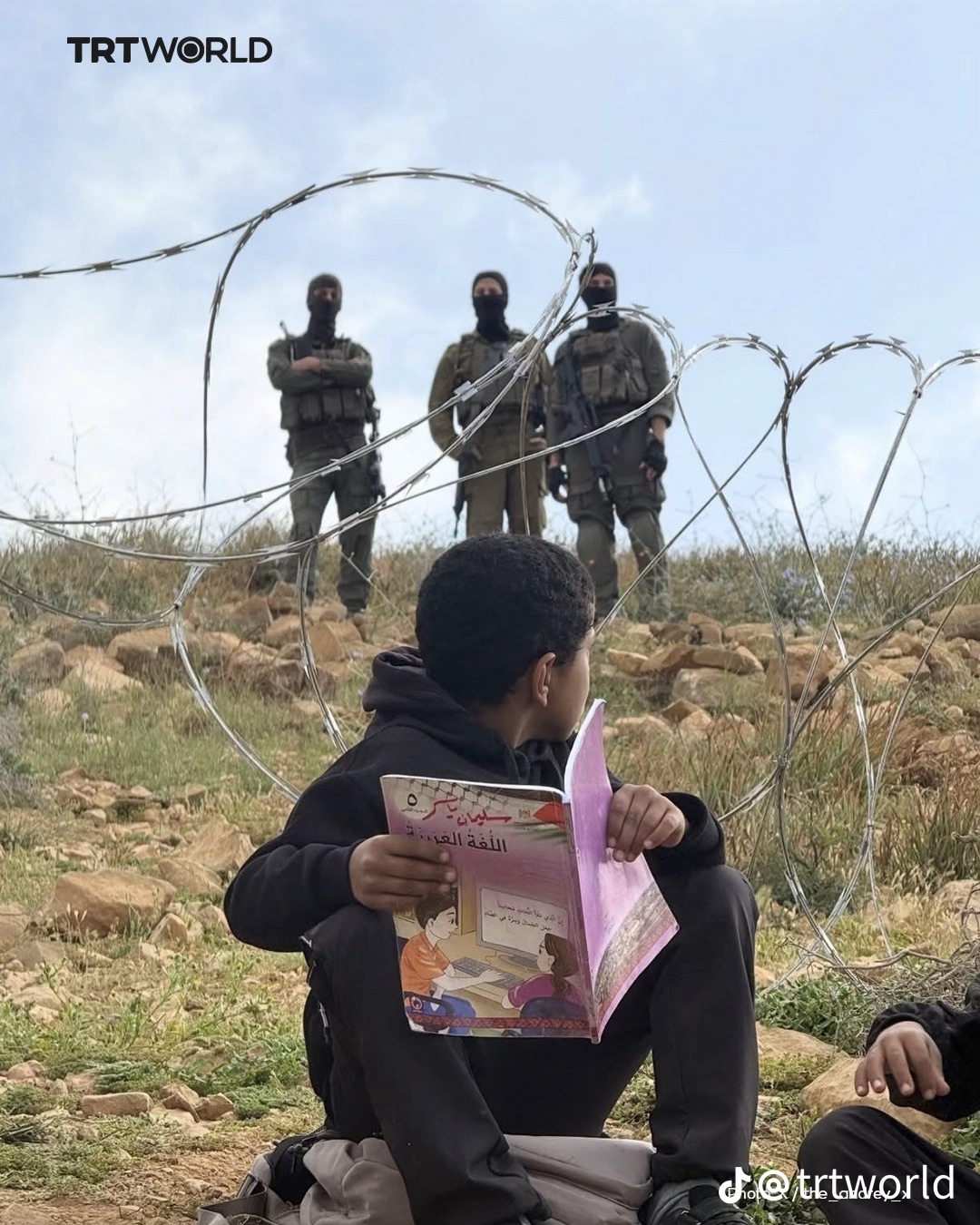
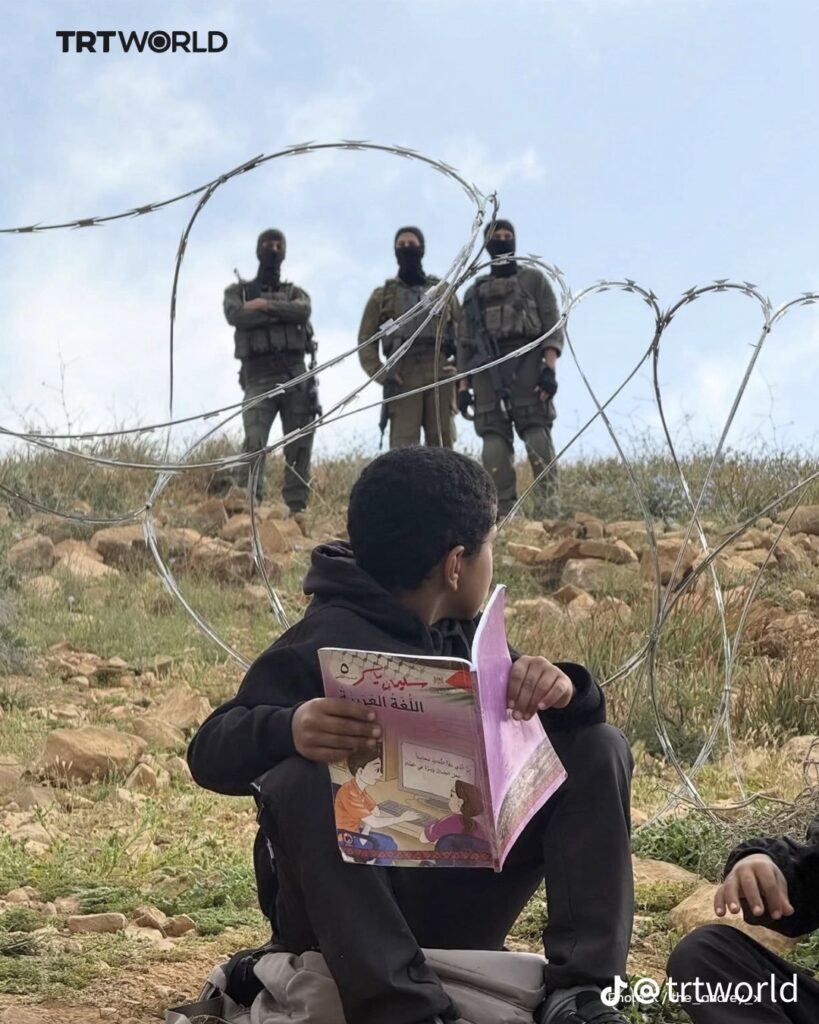
In the rocky, sun-bleached landscape of Umm al-Khair — a small Bedouin community in the southern West Bank — a photograph has stopped the world in its tracks. A child, his back turned to the camera, sits on the ground clutching an Arabic-language textbook. Behind him, coils of razor wire glitter in the pale light. And behind the wire, three heavily armed soldiers in full tactical gear and black face coverings stand and watch the boy read.
The image was shared by TRT World and quickly spread across social media, where it was used by figures including NBA star Kyrie Irving to express solidarity with Palestinians. But behind the viral moment lies a story of quiet, extraordinary defiance — and of a military occupation that has stooped to blocking children from reaching a schoolhouse.
A Path Blocked in the Night

The children of Umm al-Khair have used the same path for decades to reach their school roughly a kilometre away. When a ceasefire allowed Palestinian schools in the West Bank to reopen — even if only three days a week — the children arrived to find a barbed wire fence had been erected overnight, blocking their route entirely.
Security camera footage recorded by community members showed settlers coming during the night to erect the barbed wire fence. Despite being erected without legal authorisation, soldiers refused to take down the barrier — in a community that already faces imminent Israeli demolition orders due to a lack of building permits. Such permits, as is well documented, are rarely if ever granted to Palestinians in Area C of the West Bank, territory under full Israeli military control.
When the children tried to find another way around, IDF soldiers launched tear gas and sound grenades at them — some as young as five years old. And yes. Firing chemical weapons and explosive devices at children walking to school is a war crime.
Shortly after the fence went up, a large Star of David was built with stones by settlers on the side of the fence that the Palestinian schoolchildren can no longer access. The message was unmistakeable.
Masa Hathaleen, just five years old, stood before the barbed wire and pleaded: “I am Masa. Please open the road for us. We want to go to school. We are not doing anything wrong. We just have our books. We love our school.” 
Mira Hathaleen, ten years old, said at the protest that she wants to be a doctor. “If I want to be a doctor, I must learn and have knowledge,” she said. “We are children like the children of the rest of the world. They go to school, and we don’t.” 
These are not the words of combatants. They are the words of children who want nothing more than a classroom.
In response, the community launched what they called the “Umm al-Khair Freedom School” — marching alongside the schoolchildren right up to the fence as the children banged on drums and sang defiant songs while soldiers watched from metres away. For stretches of time, the children sat down on rocks adjacent to the barbed wire, took out their books, and began working on schoolwork they had been deprived of for more than 50 days. 
It was during one of these moments that the now-famous photograph was taken.
The Weight of 50 Days Without School

The path had been established in 1980 and is recorded on both Israeli Civil Administration and Palestinian maps as a designated pedestrian route for students. It also serves women walking to a nearby health clinic and worshippers heading to the mosque — which they also can no longer access.
Israeli authorities offered an alternative route roughly 3km in length — three times the original distance — but residents unanimously rejected it because of the conditions attached.
“You feel useless that kids can’t reach their school because of this blockade,” said Eid Hathaleen, a community member. “The kids try to show their voice, try to make the best of the situation, but they’re frustrated. They do some lessons in their homes, but it’s not enough.” 
“It was a very violent situation,” said Khalil Hathaleen, the head of the village council. “Until now, some children haven’t returned to the site because of fear. They can’t sleep.” 
What a Photograph Reveals

The viral image carries no caption that could be disputed, no political commentary that could be dismissed. It simply shows what is: a child trying to learn, and soldiers positioned to prevent it.
This is not a new story. In the West Bank village of Tuqu, pupils have long passed by barbed wire fencing and armed Israeli soldiers every single morning. A ten-year-old named Mohammed Sabah described it plainly: “They put this here to scare us, because the kids don’t like the barbed wire — it cuts our hands and our clothes and bags all the time. But we were already scared.”
A school administrator noted: “Once they get to school, they should be ready to start the day, but often the kids are showing each other the tears in their jeans or the cuts on their hands from the barbed wire.” 
The illegal occupation does not only displace and dispossess — it interrupts childhood itself. It turns the walk to school into a gauntlet. It makes a textbook an act of protest.
The Boy With the Book

We don’t know the boy’s name. We know he sat on occupied ground, held an Arabic textbook, and kept reading while three armed men watched him from behind wire they had no right to put there.
That’s it. That’s the whole story of Palestine in one frame.
A people who have had everything taken — their land, their homes, their children, their future — and still show up with books. Still teach. Still learn. Still exist.
And a military that has bombed hospitals, bulldozed homes, gassed toddlers on their way to school, and calls itself the most moral army in the world.
The wire didn’t stop him. It never has and it never will.
That’s what they can’t stand. Not the stones. Not the resistance. The reading. The refusing to disappear. The insistence on being human in the face of a system built to make you feel like less than one.
They have F-35s. They have American money and European silence and a UN Security Council veto used like a shield for war crimes.
He has a textbook.
And he’s still winning…
Sources:
Reuters. “Settlers block Palestinian pupils’ path to West Bank school with barbed wire.” April 16, 2026. Byline: Nuha Sharaf & Yosri Aljamal. https://www.al-monitor.com/originals/2026/04/settlers-block-palestinian-pupils-path-west-bank-school-barbed-wire
Associated Press. “Israeli settlers block Palestinian kids’ path to school with tear gas and barbed wire.” April 15, 2026. Byline: Sam Metz & Jalal Bwaitel. https://www.wral.com/news/ap/1b781-israeli-settlers-block-palestinian-kids-path-to-school-with-tear-gas-and-barbed-wire/
CNN. “Israeli settlers’ razor wire blocks children’s school route.” April 27, 2026. https://edition.cnn.com/2026/04/27/world/video/israeli-settlers-barbed-wire-west-bank-blocks-palestinian-children-from-school-salman-vrtc
Save the Children International. “OPT: West Bank children hold tenth day of peaceful protest after school blocked by Israeli settlers.” April 2026. https://www.savethechildren.net/news/opt-west-bank-children-hold-tenth-day-peaceful-protest-after-school-blocked-israeli-settlers
Jewish Currents. “No School in Umm al-Khair.” April 2026. https://jewishcurrents.org/no-school-in-umm-al-khair
Jerusalem Post. “Israeli settlers block Palestinian students’ path to West Bank school with barbed wire.” April 2026. https://www.jpost.com/middle-east/article-893285
TRT World. Photograph. “@trtworld.” April 2026. https://www.trtworld.com